 Available in US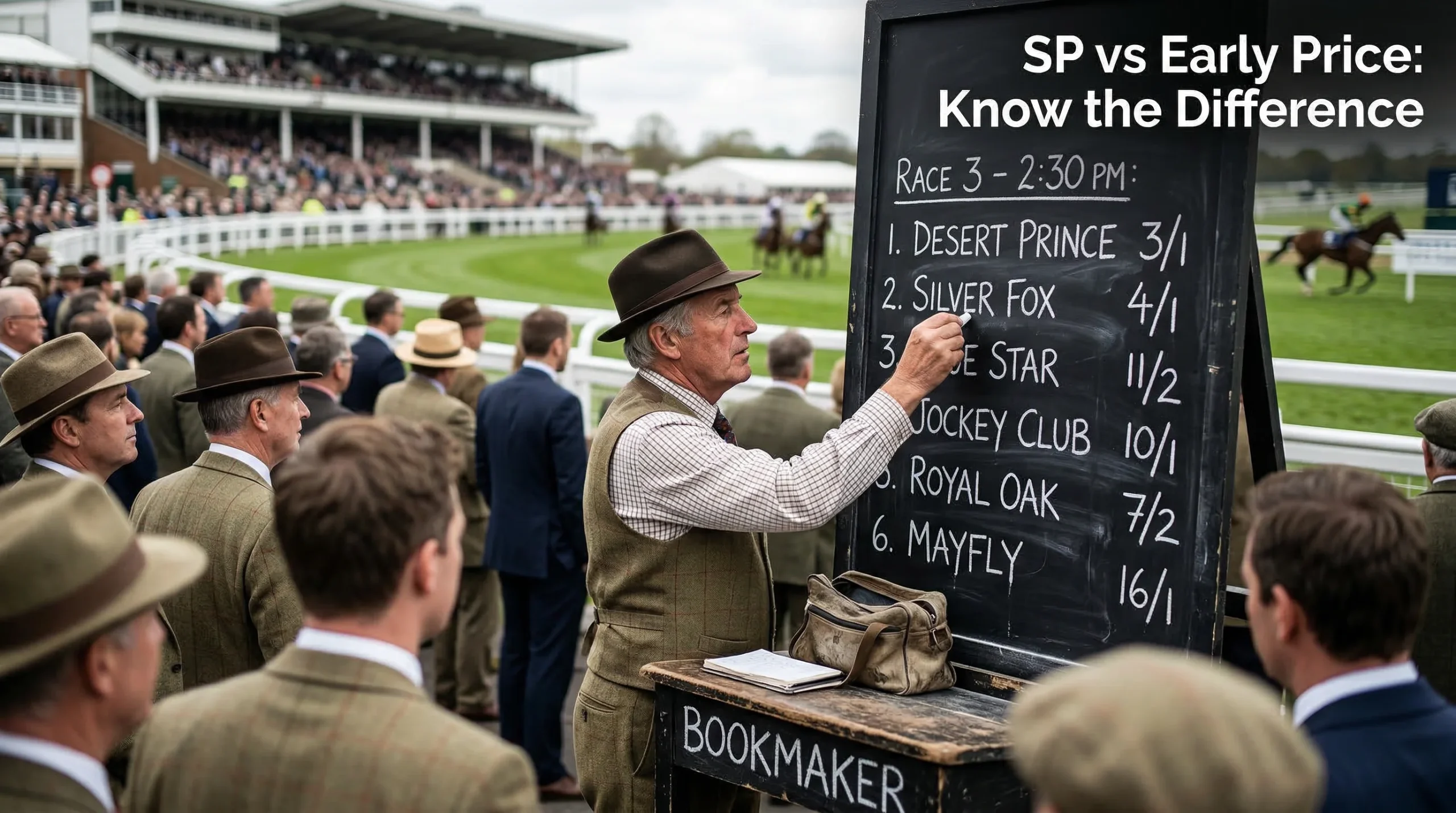
Every horse race begins with a starting price, the official odds determined at the moment the race starts. For decades, SP was the only option for most punters, with fixed odds available only to those physically present at the track. Now, online betting offers fixed prices from early morning until the off, creating a choice that barely existed a generation ago.
The decision between taking an early price and waiting for SP affects returns more than many punters realise. A horse backed at 5/1 in the morning might start at 3/1 or 7/1, depending on how money flows through the market. Getting this decision right consistently adds percentage points to long-term returns. Getting it wrong costs money through repeatedly accepting inferior odds.
Understanding how starting prices form, when early prices offer value, and how Best Odds Guaranteed connects the two approaches helps develop timing instincts that improve betting outcomes.
How the Starting Price (SP) is Calculated in UK Racing
The Starting Price represents the consensus odds at race off time, derived from on-course bookmaker prices. Designated SP reporters record the odds displayed by licensed on-course bookmakers in the moments before the start. These recorded prices are then processed through a formula that produces the official SP for each runner.
The British Horseracing Authority oversees SP formation through its regulations governing on-course betting. The system aims to reflect genuine market conditions rather than any single bookmaker’s position. Multiple bookmakers contributing to the sample reduces manipulation risk and produces prices that reasonably represent collective opinion at race time.
On-course markets differ from online markets in important ways. The volume is smaller, concentrated among professionals and serious punters present at the track. This concentrated money often reflects informed opinion about going conditions, horse demeanour, and late intelligence unavailable to online bettors. SP therefore incorporates information that morning prices cannot.
SP fluctuates more dramatically in weaker races. When on-course betting is light, a single significant wager can move prices substantially. In these circumstances, SP becomes less reliable as a measure of true probability and more a reflection of individual betting decisions. Major races with heavy on-course interest produce more stable SP formation.
The traditional on-course market has shrunk considerably as betting has migrated online. Fewer pitches at courses, reduced turnover, and changed attendance patterns mean SP formation relies on a smaller base than historically. This evolution has prompted periodic discussions about alternative SP mechanisms, though the traditional system persists.
Understanding SP formation helps interpret price movements. A horse drifting from 4/1 in the morning to 6/1 SP signals that informed money on course did not support the horse. A horse shortening from 8/1 to 4/1 suggests on-course punters knew something the morning market missed. These signals, while imperfect, provide feedback on your betting decisions.
When to Take Early Price vs Starting Price
The core question is whether you expect SP to be higher or lower than the current price. If you believe money will come for your horse, take the early price before it shortens. If you expect drift, waiting for SP captures better odds. Simple in theory, difficult in practice.
Horses with public profiles tend to shorten. Favourites, previous course winners, and horses with recent success attract support from casual punters betting closer to race time. If you back these horses in the morning, you often secure better prices than SP delivers. The morning price reflects professional assessment; the SP includes recreational money that tends to follow obvious form.
Horses with negative profile factors often drift. Returning from layoffs, switching trainers, or running on unfamiliar ground creates uncertainty that casual punters avoid. These horses may hold their morning price or drift as the market fails to support them. Taking SP on these horses sometimes captures value as the public’s reluctance pushes prices out.
Information asymmetry favours different choices. If you have no particular insight beyond publicly available form, taking early prices on well-backed horses protects against shortening. If you possess genuine private knowledge, whether from connections, paddock inspection, or market intelligence, SP might move in your favour as others receive the same information.
Race type influences optimal timing. Feature races with strong ante-post interest see less SP movement because prices have already been well-established over weeks. Maiden races and lower-grade handicaps with thinner ante-post markets see greater volatility, making timing choices more consequential.
Many bookmakers offer prices from 8:00 or 9:00 on race mornings. BOG coverage typically begins at these times too. Taking prices at market open captures maximum value when horses shorten, while waiting offers opportunity when prices drift. The optimal approach varies by horse and race, requiring judgment rather than mechanical rules.
How Best Odds Guaranteed Changes the Calculation
Best Odds Guaranteed fundamentally alters the early-price-versus-SP decision. With BOG, you take your fixed early price but receive SP if it is higher. This asymmetry eliminates the penalty for taking early prices that subsequently drift. You capture the better of two outcomes without predicting which will be better.
BOG makes early-price betting almost universally preferable when available. Taking an early price with BOG means you benefit from any shortening while being protected against drift. The only scenario where SP without BOG beats early price with BOG is when you could not access early markets at all.
BOG start times matter for practical application. Most major bookmakers begin BOG at 8:00 or 9:00. Prices taken before these times may not qualify for BOG protection, meaning early morning bets carry genuine timing risk. Checking BOG status before confirming bets ensures expected protection applies.
BOG limits constrain value for larger punters. A bookmaker might offer BOG but cap the benefit at £500 or £1,000 extra payout. For recreational stakes, this limit rarely binds. For serious punters backing horses at significant volume, BOG caps reduce its protective value. Understanding specific limits helps assess how much protection you actually receive.
Not all bookmakers offer BOG. William Hill notably discontinued it, while others maintain it with varying terms. Before assuming protection, verify current availability with your chosen operator. Terms change, and relying on outdated assumptions costs money when SP drifts without BOG safety.
BOG does not apply to all bet types. Ante-post bets, tote bets, and sometimes each-way bets may be excluded. Early prices on specific races or meetings might fall outside BOG terms during certain promotions. Reading small print prevents disappointment when expecting BOG protection that does not apply.
Practical Timing Strategies
A simple framework guides most situations. When BOG applies, take early prices confidently. You receive the best of both worlds without needing to predict market movement. The only consideration is ensuring BOG coverage has commenced before placing your bet.
Without BOG, assessment becomes necessary. Horses likely to attract support should be backed early. Horses likely to drift can be left to SP. This prediction is imperfect, but patterns exist: well-fancied runners from major trainers shorten more often than not, while horses from smaller yards without recent profile tend toward stability or drift.
Watching market movements provides real-time guidance. If your intended selection shortens through the morning, taking the current price before further compression makes sense. If it drifts, waiting captures better odds. This reactive approach requires attention and flexibility but often outperforms rigid pre-race decisions.
Splitting stakes between early price and SP hedges uncertainty. Placing half your intended bet early and half at SP means you participate in both outcomes. If the horse shortens, your early bet captured value. If it drifts, your SP bet benefits. The averaging reduces both upside and downside, suiting punters who prefer smoothed outcomes.
“Timing is everything” captures the essence of SP-versus-early decisions. There is no universally correct answer, only better and worse choices in specific circumstances. Developing judgment through experience, tracking your results across both approaches, and refining your assessment of which horses move which direction improves outcomes over time. The best punters get timing right more often than not, and that edge compounds across thousands of bets.
