
 Available in US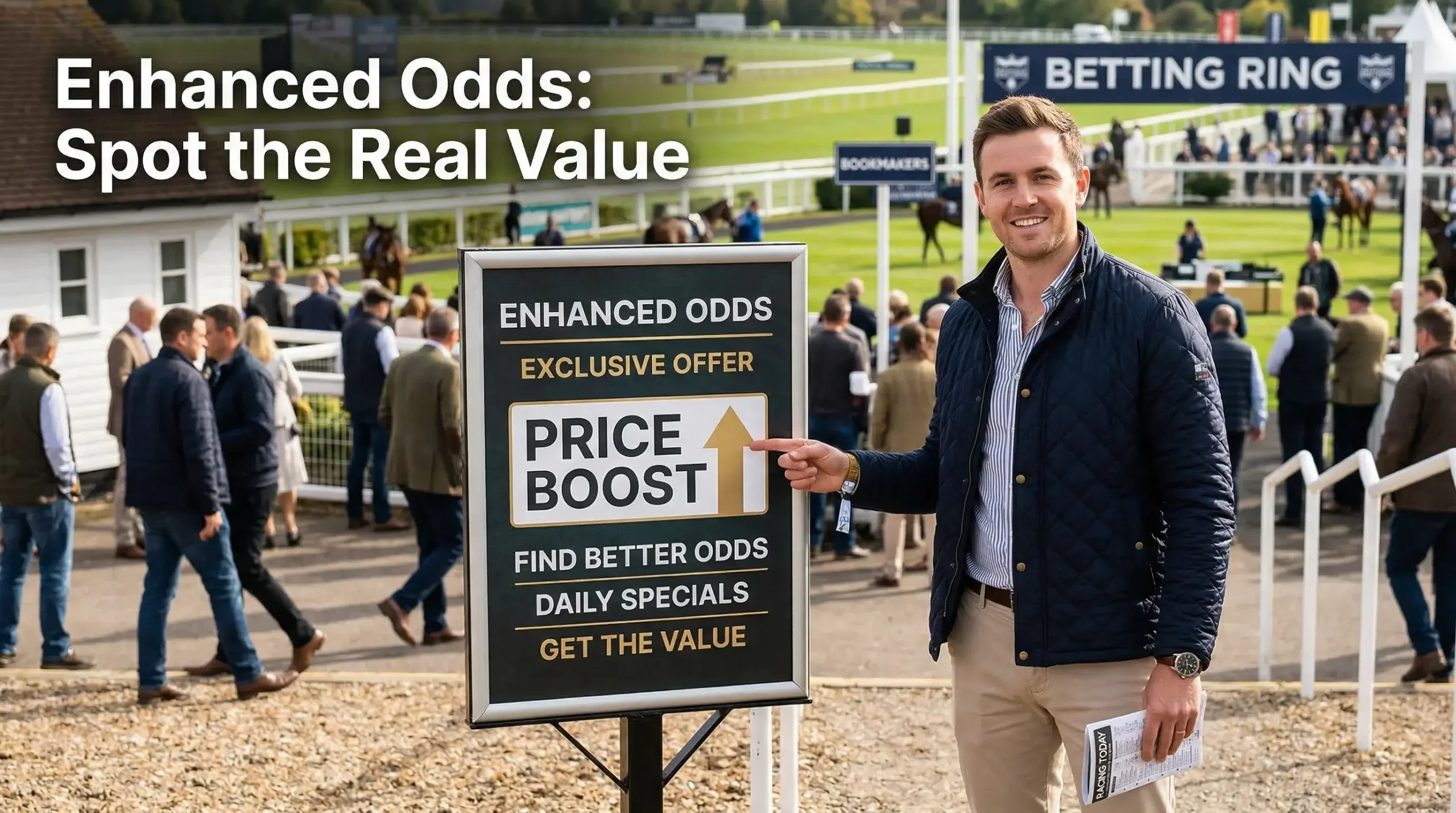
Price boosts appear everywhere in modern betting. A horse offered at 5/1 becomes 7/1 with a button click. Enhanced odds banners flash across apps and websites. The marketing suggests easy value: better odds than the market rate, available to all customers, no strings attached. The reality is more nuanced.
Bookmakers do not give away value without reason. Price boosts serve multiple purposes: attracting attention, driving engagement, and sometimes clearing liabilities. Some boosts represent genuine value transfers from bookmaker to customer. Others are marketing exercises with minimal actual benefit. Distinguishing between these categories determines whether boost hunting enhances or wastes your betting time.
Understanding why boosts exist, how to evaluate them, and when they genuinely improve expected returns helps extract real value while avoiding the illusion of bargains that are not actually there.
Horse Racing Price Boosts: Separating Value from Marketing
A genuine price boost offers odds exceeding both the bookmaker’s standard price and general market price. If a horse is 5/1 across the industry and one bookmaker boosts it to 7/1, that boost represents approximately 40% additional value on a winning bet. This is real money, and capturing it makes obvious sense.
A marketing boost offers enhanced odds that merely match or slightly exceed competitors. If a horse is 5/1 at most bookmakers but 11/2 at one operator, boosting that to 6/1 creates headlines without providing value beyond what a quick price comparison would find. The boost is technically real but practically minimal.
Comparing boosted prices to market rates determines which category applies. Oddschecker and similar comparison tools show prices across bookmakers. If the boosted price exceeds all standard alternatives significantly, value exists. If it merely competes with available prices elsewhere, the boost is presentation rather than substance.
The implied probability calculation reveals boost magnitude more precisely. A horse at 5/1 implies 16.7% probability. The same horse at 7/1 implies 12.5% probability. If true probability sits somewhere between these figures, the 7/1 offers better value. If true probability is actually lower than 12.5%, the boost still does not represent a good bet, just a less bad one.
Horses chosen for boosts are not random. Bookmakers select horses where their liability is low or where they want to attract action. Popular horses with heavy existing support rarely receive significant boosts because the bookmaker already has exposure. Outsiders or horses with limited public backing are more likely targets because additional action poses less financial risk.
This selection pattern means boosts often appear on horses that would not otherwise attract professional attention. The boost provides value, but the underlying selection may lack genuine winning potential. Value betting requires both a good price and a real chance of winning. Boosts address only the first component.
Comparing Boost Quality Across Bookmakers
Bet365 offers daily price boosts across multiple sports including racing. The enhancements are typically modest, perhaps 10-20% above standard prices, but they appear consistently. The reliability makes them worth checking regularly even if individual boosts rarely provide dramatic value.
Paddy Power markets boosts aggressively with attention-grabbing presentation. The enhancements sometimes reach substantial levels, 50% or more above standard prices, particularly on special markets or combination bets. However, these headline boosts often apply to selections with low underlying probability, making the percentage enhancement less meaningful in absolute terms.
Sky Bet integrates boosts with broader promotional activity. Racing boosts appear alongside football and other sports, with dedicated sections highlighting current enhancements. The quality varies by day and by market, requiring regular checking to identify genuinely valuable offers.
William Hill’s boost activity has fluctuated, with periods of aggressive promotion and periods of reduced activity. Current offerings should be verified directly rather than relying on historical patterns. The operator’s promotional strategy continues to evolve.
Betfair sportsbook offers boosts while the exchange maintains market-driven prices without operator intervention. This dual structure creates comparison opportunities: checking whether sportsbook boosts actually beat exchange prices reveals which offer genuine value. The exchange effectively provides a benchmark for evaluating boosted prices.
Smaller operators sometimes offer more aggressive boosts to compete for attention. The trade-off is that these bookmakers may have stricter stake limits or less reliable payment records. Chasing marginal boost value at operators with other disadvantages may not net positive overall.
Why Maximum Stakes Limit Value
Almost all price boosts carry maximum stake restrictions. A horse boosted to 10/1 might accept only £10 maximum bet at that price. This cap limits total value extraction regardless of how good the boost appears. You simply cannot bet enough to make it worth more than a small absolute amount.
Typical maximum stakes range from £10 to £50 on individual horse racing boosts. Higher limits sometimes appear on major race features or combination offers, but three-figure maximums are rare. These limits exist precisely because unlimited stakes would expose bookmakers to unacceptable losses on genuinely valuable boosts.
Calculating absolute value from capped boosts provides perspective. A boost from 5/1 to 7/1 on a £20 maximum stake offers £20 extra profit if the horse wins. That £20 requires placing the bet, monitoring the race, and accepting the outcome risk. Whether £20 potential justifies that activity depends on individual circumstances and how many similar opportunities exist.
For professional bettors, individual boost values rarely justify focused attention. The time spent identifying, placing, and settling a £20 maximum boost could be allocated to larger edge opportunities. For recreational bettors betting at similar stake levels anyway, boosts add value without demanding additional time investment.
Attempting to circumvent maximum stakes through multiple bets typically fails. Bookmakers monitor for related accounts and may void bets placed by the same person under different identities. Even where technical circumvention is possible, the terms violation risks account closure and balance forfeiture. Accepting limits as genuine constraints is safer than testing enforcement.
Some boosts accept larger stakes but pay enhanced odds only up to a certain payout level. A boost to 10/1 might pay at enhanced odds on the first £200 winnings only, with any excess settling at standard price. Reading payout terms as well as stake limits reveals true maximum benefit.
When Price Boosts Are Worth Taking
Boosts add value when they appear on horses you would back anyway at standard prices. If your analysis identifies a horse as a strong proposition at 5/1, finding that same horse boosted to 7/1 increases expected returns without requiring additional analysis or alternative action. This is pure value capture.
Boosts subtract value when they divert attention from better opportunities. If you spend time each day scanning boosts across five bookmakers, that time has an opportunity cost. Unless the boosts captured exceed what you would find through other research, the diversion is net negative. Efficient punters integrate boost checking into existing routines rather than making it a separate activity.
Combination boosts, where multiple selections must win for enhanced odds to apply, carry exponentially reduced probability. A boost offering 100/1 on a four-horse accumulator might sound impressive until you calculate that four independent 4/1 shots produce roughly 0.16% combined probability. The enhancement is real, but 100/1 on a 600/1 true probability event remains poor value.
Daily boost habits work best when selective. Checking available boosts during your normal betting routine identifies relevant opportunities. Taking boosts only when they align with existing intentions captures value without chasing marginal offers. Treating boosts as occasional bonuses rather than primary strategy maintains focus on sound selection.
Recording boost outcomes over time reveals personal patterns. Tracking which boost types you take, at what odds, and with what results clarifies whether boost hunting adds or subtracts from your overall performance. Data trumps intuition; if your records show boost bets underperforming regular selections, adjusting approach makes sense regardless of how attractive the marketing appears.
