 Available in US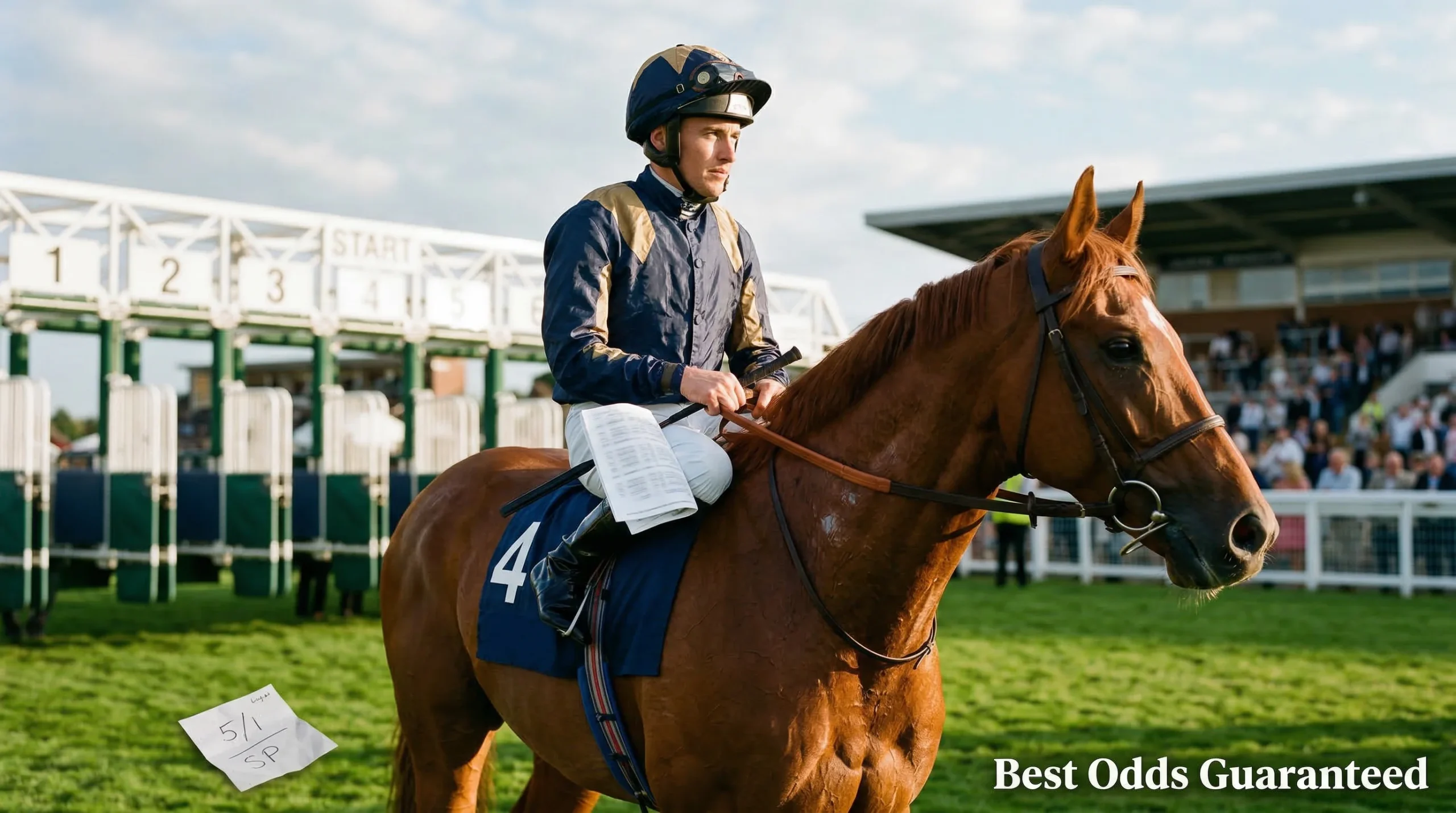
Best Odds Guaranteed ranks among the most valuable promotions in horse racing betting, yet many punters either misunderstand how it works or fail to appreciate the financial benefit it provides. The concept is straightforward: if you back a horse at a certain price and the starting price drifts higher, you receive the better odds. It functions as free insurance on your early prices, protecting you against market movements that would otherwise cost you money.
The value becomes apparent with an example. You back a horse at 8/1 on Tuesday morning. By race time on Saturday, the horse has drifted to 12/1 at the starting price. Without Best Odds Guaranteed, your bet pays at 8/1. With BOG, you receive 12/1 automatically. On a £50 stake, that difference represents £200 in additional profit if the horse wins.
This asymmetry matters because it removes one of the key risks of early betting. Taking a price days before a race exposes you to information arriving later that moves the market. An injury report, ground conditions changing, or simply more money arriving for a rival can all cause your selection to drift. BOG eliminates the downside of these movements while preserving the upside: if the price shortens, you keep the better early price you took.
However, the detail beneath the headline determines the actual value. Bookmakers apply different start times for BOG protection, impose varying daily limits on additional payouts, and exclude certain race types entirely. Understanding these variations helps you choose where to place your bets and how much genuine protection you actually receive. The differences between operators can be substantial, turning a seemingly standard offer into a genuine competitive advantage or a marketing gesture with limited practical value.
How Best Odds Guaranteed (BOG) Works in Horse Racing
The mechanics of Best Odds Guaranteed involve comparing two prices: the odds you accepted when placing your bet and the starting price when the race begins. If the starting price exceeds your bet price, the bookmaker pays you at the higher odds. If the starting price equals or falls below your bet price, nothing changes. The bet settles at your original odds.
Consider a practical example. You back a horse at 8/1 on Thursday morning for a Saturday race. By Saturday afternoon, market activity has pushed the price to 12/1 at the off. With BOG, your winning bet pays at 12/1 rather than 8/1. On a £10 stake, that difference amounts to £40 in additional profit. You took the early price, perhaps because you anticipated the horse would shorten, but received the benefit when the market moved the other way.
The reverse scenario delivers no additional benefit but costs nothing either. If you back a horse at 8/1 and it shortens to 5/1 by the off, your bet remains at 8/1. BOG protects against adverse movement without penalising you for taking prices that prove to be value.
Starting price determination follows established industry procedures. The official SP reflects the odds available in the on-course betting ring at the moment the race starts. This differs from the exchange price or the odds displayed on bookmaker websites, though in practice these figures usually align closely. Some operators pay to their own SP rather than the industry SP, a distinction that occasionally creates minor discrepancies.
BOG applies to winning bets only. If your horse finishes second, the guarantee provides no benefit regardless of price movements. Each-way bets receive BOG on both the win and place portions, meaning a placed horse benefits from any price drift that occurred. This makes each-way betting particularly compatible with BOG strategies.
The guarantee activates automatically at most bookmakers. You do not need to opt in, claim a bonus, or take any action beyond placing your bet. The enhanced odds appear in your account when the bet settles. Some operators display the BOG adjustment separately in your bet history, showing the original odds alongside the enhanced payout.
Timing matters because BOG typically applies only to bets placed after a specified hour. A bet placed at 7am might not qualify for BOG even if the same bet placed at 9am would. Understanding your bookmaker’s start time ensures you do not miss out through poor timing.
The distinction between fixed odds and starting price bets creates an important nuance. BOG applies when you take a specific price at the time of betting. If you request SP instead, accepting whatever odds the market produces at race time, BOG becomes irrelevant. The comparison mechanism requires a fixed price to compare against the starting price. SP betting has its own merits but forfeits the potential BOG benefit.
Multiple bets on the same horse can each receive BOG treatment. If you place a morning bet and add another wager later, both qualify for BOG independently. This matters when early information seems uncertain and you want to add to your position as confidence grows. Each bet receives protection based on its own original price.
UK Bookmaker BOG Comparison
The variation between bookmakers on BOG terms creates meaningful differences in value. Some operators offer generous limits that accommodate serious punters. Others impose caps that limit the benefit to recreational stakes. Knowing where to place different sized bets optimises the protection you receive.
Sky Bet stands out for offering one of the highest daily BOG limits in the industry. According to GG.co.uk, Sky Bet’s daily BOG limit reaches £50,000. This figure accommodates virtually any recreational punter and provides meaningful protection even for significant stakes. A £1,000 bet at 10/1 drifting to 15/1 generates an additional £5,000 in profit, well within the limit.
Ladbrokes operates with a substantially lower ceiling. The Ladbrokes BOG limit sits at £2,500 per day, according to horseracing.net. This remains adequate for most punters but creates constraints for those placing larger bets or multiple substantial wagers across a day’s racing. Reaching the cap means subsequent bets that day receive no BOG protection.
Coral, part of the same group as Ladbrokes, maintains its own BOG policy with similar characteristics. The limits and terms broadly align with its sister brand, though the specific cap may differ slightly. Both brands share underlying systems, so the application tends to be consistent.
Paddy Power offers BOG with terms that have remained relatively stable over recent years. The Irish bookmaker applies BOG to UK and Irish racing, with standard limits that suit most recreational betting. The brand’s promotional style sometimes includes enhanced BOG periods during major festivals.
Betfair Sportsbook, distinct from the Betfair Exchange, offers BOG but with some restrictions. Not all customers receive BOG automatically, and the terms can vary based on account status. Checking your specific eligibility before relying on BOG protection makes sense with this operator.
Bet365 combines BOG with an additional feature called Best Odds Guaranteed Plus, which enhances returns on successful bets where the SP exceeded the bet price. The standard BOG applies from 8am on race days, placing bet365 among the earlier start times in the market.
BoyleSports offers BOG from 8am with terms aimed at the recreational market. The Irish bookmaker maintains straightforward conditions without excessive exclusions, making the offer easy to understand and use.
Betway and BetVictor both provide BOG from 9am rather than 8am, creating a one-hour window where early morning bets do not qualify. This distinction matters primarily for punters who bet on the first race of the day or who place bets before leaving for work.
The comparison reveals no single best option for all circumstances. Sky Bet’s high limit suits larger bets. Early risers benefit from bookmakers offering 8am start times. Punters who prioritise simplicity might prefer operators with fewer exclusions even if limits are lower. Matching your betting profile to the right bookmaker maximises the value you extract from BOG.
Start Times and Payout Limits
The timing of BOG activation creates a hierarchy among bookmakers. The earliest operators switch on protection at 8am, covering bets placed from that point until the race starts. This group includes bet365, Ladbrokes, Coral, BoyleSports, and Paddy Power. For punters who review race cards over breakfast and place morning bets, these operators provide full coverage.
A second tier activates at 9am. Sky Bet, Betway, and BetVictor fall into this category. The one-hour difference rarely matters for afternoon racing, but early morning meetings occasionally start before the 9am window provides meaningful coverage. A bet placed at 8.30am for an 11am race misses BOG entirely at these operators.
Bet365 adds complexity with a tiered timing structure. Standard BOG applies from 8am. However, from 10am on ITV Racing days, bet365 guarantees to match prices available at Ladbrokes, William Hill, Paddy Power, Coral, Sky Bet, and BoyleSports, according to the Racing Post. This effectively extends BOG into competitive price matching for televised races, covering the most prominent fixtures.
Daily limits introduce another layer of consideration. The limit represents the maximum additional payout BOG will provide in any single day. Once you reach that limit, subsequent winning bets settle at your original price regardless of SP movements. For punters placing multiple significant bets across a Saturday card, these limits can genuinely constrain value.
Sky Bet’s £50,000 daily limit sits well above typical betting activity. Even dedicated punters rarely approach this ceiling through normal betting patterns. The generous limit functions more as a statement of intent than a practical restriction for most customers.
Ladbrokes’ £2,500 limit operates differently. A few successful bets with meaningful price drift could approach or reach this cap. Consider a scenario where you back three horses at £200 each-way, all of which win with SP drift of several points on each. The additional profit from BOG might approach the daily limit. On big racing days with concentrated activity, this constraint becomes relevant.
Understanding how limits reset proves important for planning. Most operators reset at midnight, meaning a busy Saturday followed by Sunday racing provides a fresh limit for each day. However, some promotional periods or festival offers may involve cumulative limits across multiple days. Reading the specific terms during major meetings prevents unwelcome surprises.
The interaction between timing and limits creates strategic considerations. Placing bets early maximises the potential for price drift, but only if your bookmaker provides BOG coverage at that hour. Concentrating bets at one operator might reach limits more quickly than spreading across multiple accounts. Balancing these factors against the practical convenience of using fewer accounts shapes individual approach.
Weekday racing versus weekend racing often shows different BOG patterns. Saturday cards attract heavier betting interest, more price movement, and greater BOG opportunity. A midweek afternoon meeting at a minor track sees smaller markets, less volatility, and consequently less BOG benefit. Aligning your most significant bets with the busiest racing days optimises BOG potential.
All-weather racing deserves separate mention. The artificial surfaces at Kempton, Lingfield, Newcastle, Southwell, Chelmsford, and Wolverhampton host year-round racing that can be less familiar to many punters. Prices in these markets sometimes show more volatility as fewer specialists track the form. BOG applies equally to all-weather racing at operators who cover UK racing, making these meetings potentially fruitful for price drift.
Evening racing sessions present distinct timing considerations. Summer jumps meetings at Perth or Newton Abbot, along with flat fixtures running into evening, start after most working day activities conclude. The 8am or 9am BOG start time provides comprehensive coverage for these cards, but the later start times mean prices have longer to move before racing begins. More market participants reviewing prices through the day can generate additional drift opportunities.
What BOG Does Not Cover
Best Odds Guaranteed applies to standard win and each-way betting on UK and Irish horse racing, but numerous exclusions limit its scope. Knowing what falls outside BOG coverage prevents disappointment when bets settle at original prices despite favourable SP movements.
Ante-post betting represents the most significant exclusion. Bets placed weeks or months before a race, typically for major events like the Grand National or Cheltenham Festival, do not qualify for BOG at any bookmaker. The distinction between ante-post and day-of-race betting usually hinges on whether final declarations have been made. Once the final field is confirmed, usually the day before racing, BOG protection typically begins.
International racing falls outside BOG at most operators. Races in France, the United States, Australia, Hong Kong, and other jurisdictions generally carry no BOG protection. The occasional exception exists for high-profile international events like the Prix de l’Arc de Triomphe or the Breeders’ Cup, but these remain promotional additions rather than standard coverage.
Tote betting operates entirely outside BOG. Pool bets, including the Placepot, Jackpot, and other Tote products, use dividend-based returns that cannot interact with fixed-odds BOG mechanisms. If you bet through the Tote, you receive the pool dividend regardless of SP movements.
The most notable recent change involves William Hill restricting BOG to an invitation-only model. As of January 2025, BOG at William Hill requires customers to opt in via their race cards, and eligibility is determined at the bookmaker’s discretion. This represents a significant shift from the automatic coverage most punters expect. The £25,000 daily cap remains in place for qualifying customers, but the barrier to access marks a departure from industry norms where BOG applies automatically to all customers.
Certain bet types face restrictions even where BOG nominally applies. Forecast and tricast bets, Lucky 15 and other combination bets, and bets placed as part of promotional offers sometimes carry exclusions. The specific terms vary by operator, making it worth checking before assuming coverage.
Enhanced odds and price boost bets frequently exclude BOG. When a bookmaker offers a special price on a selection, the enhanced odds often represent the maximum return available. BOG cannot increase the payout beyond what the promotion already provides. This makes logical sense from the bookmaker’s perspective but occasionally surprises punters who expect both benefits to apply.
Account restrictions can also remove BOG eligibility. Punters whose accounts have been limited, who have triggered bonus abuse reviews, or who have otherwise drawn attention may find BOG withdrawn from their specific account even while the promotion continues for other customers. The lack of transparency around these individual restrictions makes them difficult to anticipate or challenge.
Getting the Most from Best Odds Guaranteed
Extracting maximum value from BOG requires understanding when and how price movements occur. Horses drift in price for various reasons: market intelligence suggesting an issue, money arriving for rivals, or simply the natural adjustment of poorly priced initial markets. Recognising patterns helps you position bets to benefit from potential drift.
Early prices on morning of the race often prove least efficient. Bookmakers post these prices with wide margins, leaving room for adjustment as money enters the market. Backing horses at these early prices captures any subsequent drift while BOG protects against shortening. This strategy works best with selections you genuinely believe will win, since BOG only pays on winners.
Festival races and major handicaps typically see the most dramatic price movements. The volume of betting interest, combined with uncertainty about relative form across large fields, creates conditions for significant drift. Cheltenham Festival, the Grand National meeting, and Royal Ascot all generate price volatility that BOG can capture. As Michael Shinners, Head of Sports PR at Sky Bet, noted about recent festival turnover patterns: “In general, turnover held up well over the festival, particularly as results were not punter-friendly in the main. The tweaking of the racing programme, taking out the old Turners Novices’ Chase and replacing it with a competitive handicap, probably helped.” This competitive racing attracts substantial BOG-eligible betting.
Combining BOG with free bets amplifies value further. When using a free bet, any BOG enhancement applies to your winnings. If your free bet selection drifts from 10/1 to 14/1, you receive 14/1 on your free stake rather than 10/1. This interaction makes free bets on potential drifters particularly efficient.
Each-way betting enhances BOG utility because the guarantee applies to both portions of the bet. A horse that places but does not win still benefits from any drift on the place calculation. This reduces the variance of BOG value since you do not need to find the winner to benefit from price movements.
Spreading bets across multiple operators with different limits provides insurance against hitting any single cap. If you plan significant betting across a major race day, placing your largest potential BOG beneficiaries at operators with higher limits preserves maximum upside. Smaller bets can go to operators where limits matter less.
Tracking your BOG returns over time reveals its genuine contribution to your results. Some punters find BOG adds several percentage points to their annual return on investment. Others discover it rarely activates meaningfully for their betting style. Understanding your personal pattern helps assess how much weight to place on BOG when choosing bookmakers.
The overall value proposition remains compelling. BOG costs you nothing, applies automatically, and occasionally delivers substantial additional profit. No strategy guarantees drift, but understanding the mechanics helps you position bets where BOG might pay off while avoiding situations where exclusions would prevent benefit.
Certain race types offer more BOG potential than others. Competitive handicaps with large fields generate the most price volatility. Twelve runners with similar chances produce uncertain markets where early prices shift substantially as money arrives. Contrast this with a Grade One race featuring a dominant favourite: the market tends to solidify early, reducing drift potential. Targeting your BOG strategy toward competitive handicaps maximises the opportunity for beneficial price movements.
Weather sensitivity creates additional drift scenarios. Ground-dependent horses can move several points in the market when overnight rain arrives or morning sunshine dries the course. If you back a soft-ground specialist early when good ground is expected, unexpected rain might shorten the price significantly. Conversely, betting on a horse suited by quick ground could see the price drift if rain softens conditions. BOG protects against the downside of these weather-related movements while letting you keep any advantage.
Trainer and jockey booking announcements occasionally trigger drift. A leading jockey choosing a different mount in the same race sends a signal that moves prices. First-choice jockeys being replaced through injury or other commitments can cause selections to drift. These movements happen close to race time, often after early morning prices have been set. BOG captures this late drift when it occurs.
The betting exchange price provides a reference point for assessing early bookmaker prices. If the exchange shows 10/1 and a bookmaker offers 8/1, that bookmaker price appears likely to drift as the market corrects. Taking the 8/1 with BOG protection allows you to bet immediately while capturing any drift toward the true market price. This comparison helps identify situations where BOG benefit seems most likely.
