 Available in US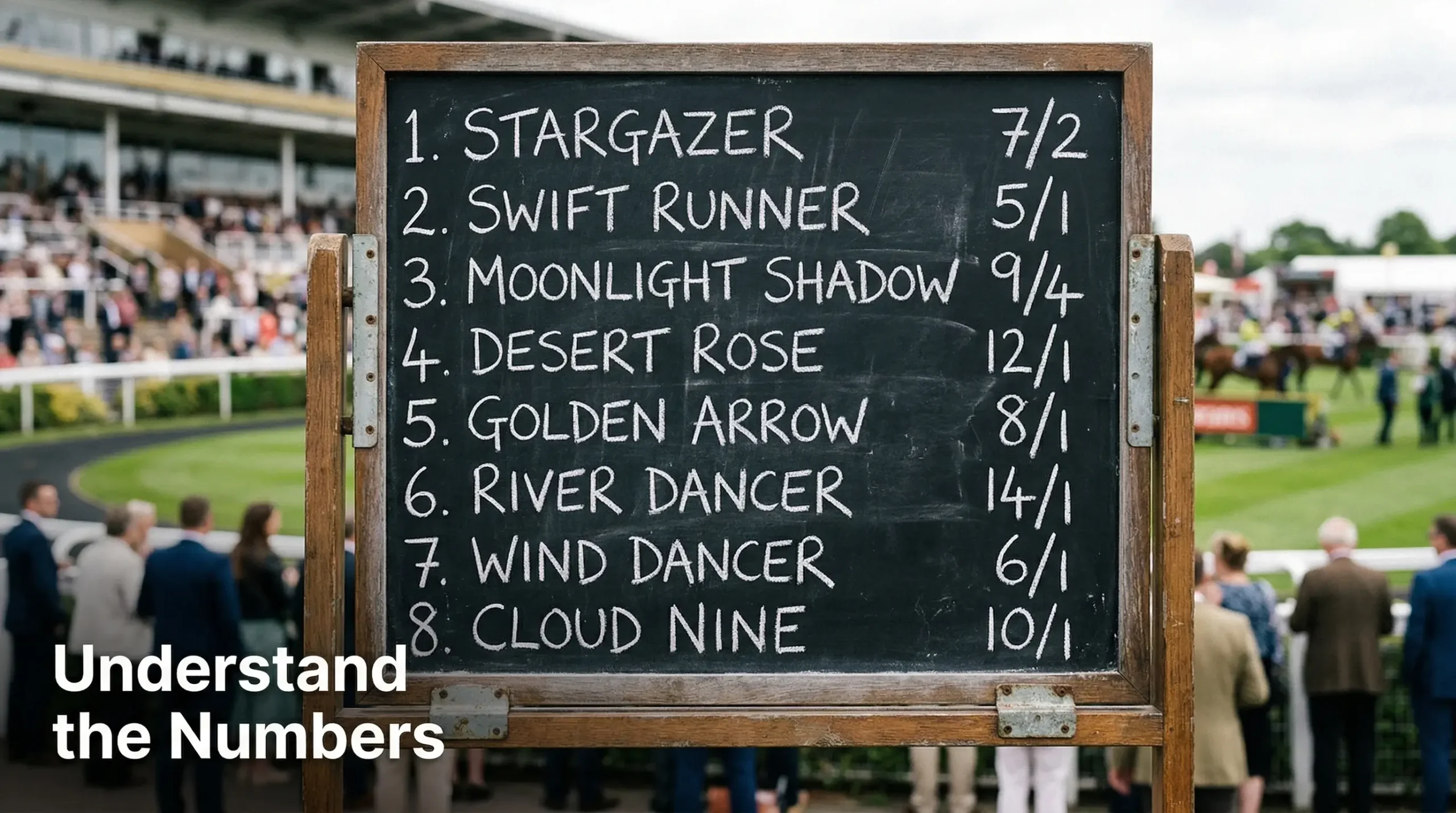
Odds express both the potential return on a bet and the implied probability of an outcome. Understanding odds formats is fundamental to betting, yet many punters place wagers without truly grasping what the numbers mean. Three formats dominate: fractional odds traditional to British racing, decimal odds common across Europe, and American odds used in the United States.
UK bookmakers typically default to fractional odds, reflecting centuries of tradition. However, most platforms allow switching to decimal format, which many bettors find easier to calculate. Knowing how to read and convert between formats ensures you can compare odds across different sources and understand what any price actually represents.
Beyond format preferences, odds reveal market assessment of probability. Learning to understand the numbers transforms odds from mysterious symbols into meaningful information about how the betting market views each horse’s chances.
Fractional Odds: The British Tradition
Fractional odds express potential profit relative to stake. Odds of 5/1, read as five to one, mean that for every £1 staked, you win £5 profit if successful. Your total return includes both the profit and your original stake, so a winning £10 bet at 5/1 returns £60: £50 profit plus £10 stake.
The first number represents potential profit; the second represents the stake required to generate that profit. At 7/2, you win £7 for every £2 staked. Scaling up, a £10 bet at 7/2 wins £35, with £45 total return. The relationship is proportional regardless of actual stake size.
Odds-on prices show the second number larger than the first. At 1/2, you stake £2 to win £1. This indicates a strong favourite where you risk more than you stand to win. At 1/4, you stake £4 to win £1. These short prices reflect high implied probability of winning but offer limited returns relative to risk.
Evens, written as 1/1 or simply EVS, represents the break-even point where profit equals stake. A £10 bet at evens returns £20: £10 profit plus £10 stake. Prices shorter than evens are odds-on; prices longer than evens are odds-against.
Traditional fractions use established increments: 5/4, 6/4, 7/4, 2/1, 9/4, 5/2, 11/4, 3/1, and so on. These increments reflect historical bookmaking practice rather than mathematical precision. Modern bookmakers sometimes offer non-traditional fractions like 11/8 or 17/10 for more precise pricing.
Mental calculation with fractional odds requires practice. Quick methods exist: at 4/1, multiply stake by 4 for profit; at 7/2, halve the stake, multiply by 7 for profit; at 5/4, divide stake by 4, multiply by 5 for profit. These shortcuts speed comparison without calculators.
Decimal Odds: The European Standard
Decimal odds express total return per unit staked, including the stake itself. Odds of 6.00 mean a £1 bet returns £6 total if successful: £5 profit plus £1 stake. This format simplifies return calculation: multiply stake by odds to get total return.
The decimal format is mathematically cleaner than fractional presentation. Comparing 2.75 to 2.80 is immediately intuitive, whereas comparing 7/4 to 9/5 requires conversion or calculation. This clarity explains decimal odds’ popularity among exchange bettors and those using odds comparison tools.
Decimal odds of 2.00 equal evens: stake £1, return £2. Anything below 2.00 is odds-on; anything above is odds-against. The 2.00 threshold provides a simple reference point for understanding price positioning.
Exchange betting platforms like Betfair display decimal odds exclusively, exposing UK bettors to the format regardless of traditional preference. The precision available in decimals, such as 3.45 or 4.27, exceeds what fractional odds can elegantly express, making decimals better suited to dynamic exchange markets.
Converting from decimal to profit requires subtracting 1. At 4.50 decimal odds, the profit portion is 3.50 per unit staked. This conversion becomes automatic with practice, but initially, remembering that decimal odds include the stake prevents calculation errors.
Most UK bookmaker apps and websites allow switching between fractional and decimal display in account settings. Experimenting with both formats helps identify which you find more intuitive for your betting style.
Converting Between Formats
Converting fractional to decimal adds 1 to the fraction result. Take 5/1: divide 5 by 1 to get 5, add 1 to get 6.00 decimal. Take 7/2: divide 7 by 2 to get 3.5, add 1 to get 4.50 decimal. Take 11/8: divide 11 by 8 to get 1.375, add 1 to get 2.375 decimal.
Converting decimal to fractional subtracts 1 then expresses as a fraction. Take 3.50 decimal: subtract 1 to get 2.50, express as 5/2 fractional. Take 2.25 decimal: subtract 1 to get 1.25, express as 5/4 fractional. Non-standard fractions sometimes result, which bookmakers may round to traditional increments.
Common equivalents worth memorising include: 2/1 equals 3.00; 5/2 equals 3.50; 3/1 equals 4.00; 4/1 equals 5.00; 5/1 equals 6.00; 10/1 equals 11.00. Evens equals 2.00; 4/5 equals 1.80; 1/2 equals 1.50; 1/3 equals 1.33.
Online calculators and betting apps handle conversions automatically. However, understanding the underlying mathematics prevents dependence on tools and enables quick mental comparison when tools are unavailable.
American odds, while uncommon in UK racing, appear occasionally. Positive American odds show profit on a $100 stake: +500 means $500 profit from $100. Negative American odds show stake required to win $100: -200 means $200 stake wins $100. Converting to decimal: for positive, divide by 100 and add 1; for negative, divide 100 by the number (ignoring minus) and add 1.
What Odds Tell You About Probability
Every price implies a probability. Converting odds to probability reveals what the market believes about each horse’s chances. This information helps identify value: selections whose true probability exceeds what odds imply.
The conversion formula for decimal odds: probability equals 1 divided by decimal odds, expressed as percentage. At 4.00 decimal: 1 divided by 4 equals 0.25, or 25% implied probability. At 2.50 decimal: 1 divided by 2.5 equals 0.40, or 40% implied probability.
For fractional odds, add the two numbers, then divide by their sum. At 3/1: 1 divided by (3+1) equals 0.25, or 25%. At 5/2: 2 divided by (5+2) equals 0.286, or 28.6%. These calculations reveal what the market thinks about winning chances.
Summing implied probabilities across a race typically exceeds 100%. This overround represents the bookmaker’s margin. A race where probabilities sum to 115% contains a 15% overround. Lower overrounds mean better value for bettors; higher overrounds mean greater bookmaker edge.
Grainne Hurst, CEO of the Betting and Gaming Council, has highlighted that major racing events like the Grand National represent some of the most significant betting occasions in the national calendar, attracting vast public participation. As she noted in UK Bookmakers: “The Grand National is one of the precious few sporting events in this country with the ability to unite the entire nation around a single spectacle. It is the nation’s punt.” Understanding odds and value helps you engage with these events confidently, knowing what any price represents and whether it reflects a genuine opportunity.
Value betting identifies selections where your assessed probability exceeds implied probability. If you believe a horse has a 30% chance but odds imply only 20%, the bet offers value regardless of whether this specific horse wins. Over many such bets, positive expected value generates profit.
The mathematics of probability cuts through emotional assessment. Instead of asking whether a horse will win, ask whether its odds fairly reflect its chances. This reframing transforms betting from prediction into valuation, aligning approach with long-term profitability rather than short-term outcomes.
Practice with real races accelerates learning. Before each bet, convert the odds to implied probability and ask whether you agree with that assessment. Over time, this habit develops intuition for spotting mispriced selections. The numbers become second nature, and understanding odds transforms from academic exercise into practical advantage.
