 Freehorseracingbets.com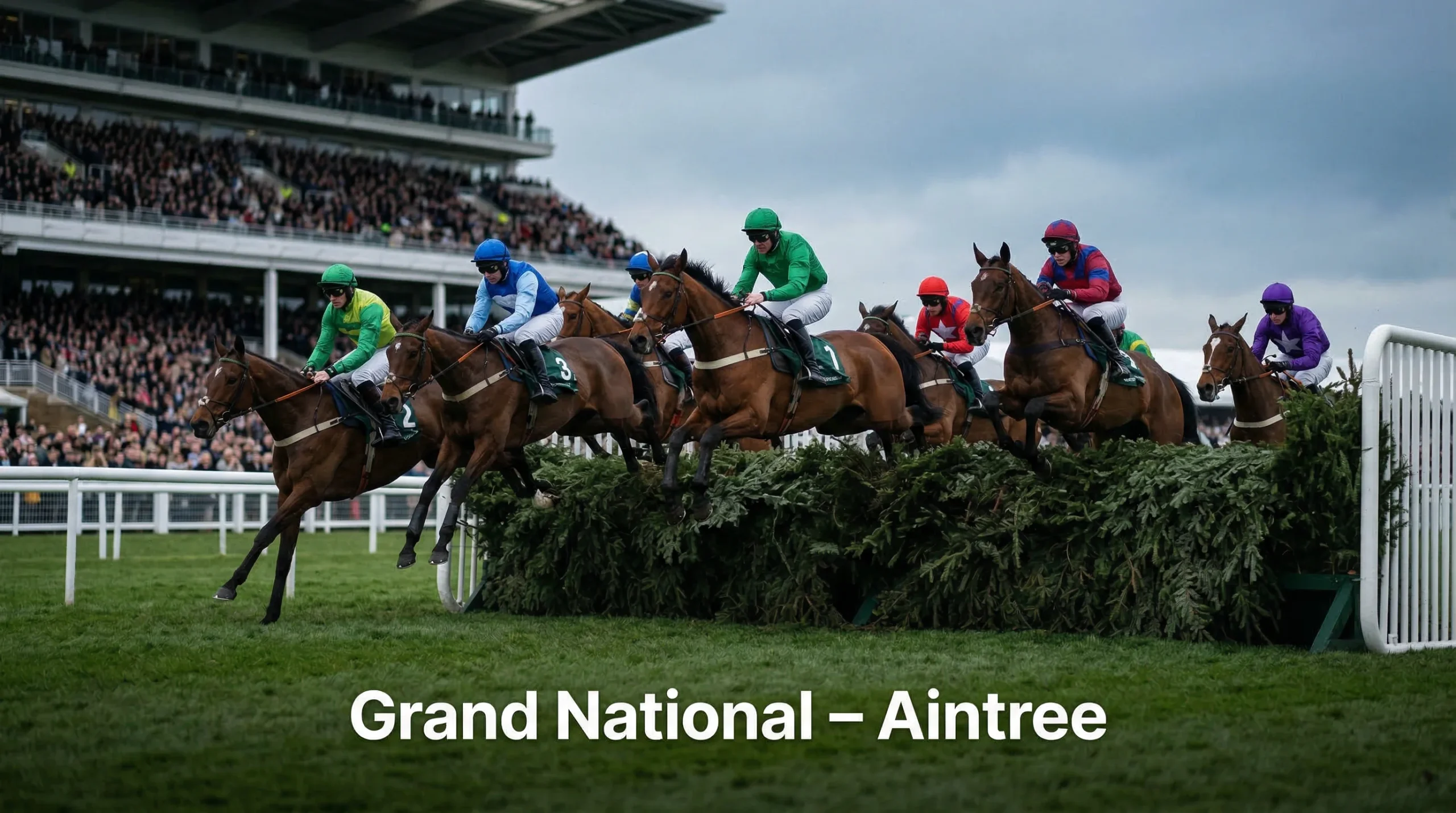
The best sites for betting on greyhound racing
Loading...
The Grand National occupies a peculiar position in British culture. It is the one horse race that people who never otherwise gamble will watch, discuss, and place a small bet on. Office sweepstakes appear in workplaces across the country. Families gather around televisions for those extraordinary few minutes at Aintree. For roughly 30% of people who bet on the race, it represents their first wager of the year, according to Entain research. Some make it their only bet of the year entirely.
This cultural significance makes the Grand National unusual from a betting perspective. The race attracts enormous promotional activity from bookmakers, but the audience differs markedly from the typical racing punter. Many people placing bets have limited experience with odds formats, bet types, or the mechanics of free bet offers. The abundance of promotions can confuse rather than help.
This guide addresses that specific challenge. We explain the betting offers available for the 2026 Grand National in straightforward terms, provide a step-by-step process for placing your bet, and give particular attention to each-way betting, which suits this race better than most. Whether this is your first Grand National bet or you simply want to approach it more methodically than in previous years, the goal is clarity over complexity.
The race presents genuine challenges even for experienced punters. Forty horses, thirty fences, four and a quarter miles. The field size alone makes accurate prediction difficult. Respected form analysts often struggle to identify winners in advance. That reality should inform how you approach your betting: this is entertainment with uncertain outcomes, not an exercise in logical deduction.
Why the Grand National Matters
The numbers tell part of the story. Expected betting turnover on the 2026 Grand National exceeds £200 million, with the entire Aintree Festival projected to generate around £250 million, according to estimates from the UK Bookmakers Association. To put that in perspective, the Grand National attracts approximately 700% more betting activity than the Cheltenham Gold Cup, which itself ranks among the most prestigious races in the sport.
This concentration of betting interest creates particular market dynamics. Bookmakers staff their operations for the surge. They compete intensely for the once-a-year punters who emerge specifically for this event. The promotional spending reflects an understanding that customers acquired on Grand National day can potentially become year-round bettors.
The race itself dates back to 1839, making it one of the oldest continuing sporting events in the world. The National’s fame derives partly from the unique obstacles at Aintree. The Chair, Becher’s Brook, the Canal Turn, Valentine’s Brook: these fences have their own names and reputations. Modern modifications have improved safety, but the challenge remains substantial. Horses who excel over regulation fences at other courses sometimes struggle with the National’s larger, stiffer obstacles.
The course extends for four miles and two and a half furlongs, making it the longest race in the calendar at this level. Horses complete two circuits, jumping 30 fences in total. The race demands stamina that goes beyond ordinary distance chasing. Horses must conserve energy for the final half-mile while still jumping safely throughout.
This combination of extreme distance, unique obstacles, and large field sizes explains why the Grand National produces unpredictable results. Favourites win less frequently than in most other major races. Horses at double-figure odds regularly triumph. The 2024 winner, I Am Maximus, started at 11/2, which represents a relatively short price for this race. Many recent winners have come from deeper in the market.
The race captures attention beyond racing circles partly because of this unpredictability. When anyone’s selection has a chance, however remote, the race becomes genuinely participatory. The office sweepstake where someone draws a 66/1 outsider still offers hope. That hope, however mathematically improbable, sustains interest through those eight or nine minutes of racing.
Cultural significance translates into viewing figures that dwarf other racing events. The Grand National regularly attracts television audiences exceeding eight million. Radio coverage reaches millions more. Social media activity spikes. For this single afternoon, horse racing occupies mainstream attention in a way that no other fixture manages.
Grand National Betting Offers Compared
Bookmakers treat Grand National week as a major promotional opportunity. The offers cluster into familiar categories, each with distinct mechanics and varying degrees of genuine value. Understanding these differences prevents disappointment when the fine print contradicts the headline.
New Customer Welcome Bonuses
The standard format requires placing a qualifying bet to unlock free bets in return. Grand National offers typically increase the free bet amount compared to regular promotions. Where a bookmaker might ordinarily offer £30, National week often sees figures of £40, £50, or occasionally higher.
Qualifying requirements deserve scrutiny. Most offers specify minimum odds for the qualifying bet, typically around 1/2 or Evens. This prevents customers from backing near-certainties to trigger the bonus with minimal risk. The qualifying bet must settle before the free bets become available, which means betting on events before the National if you want to use your free bets on the race itself.
Free bets almost universally operate on a stake not returned basis. If you place a £20 free bet on a horse at 5/1 and it wins, you receive £100 rather than £120. The free bet value disappears whether you win or lose. This effectively reduces the value of any free bet offer by the probability-weighted stake value.
Some operators now split welcome offers across multiple smaller bets rather than one larger sum. Receiving four £10 free bets instead of one £40 bet offers flexibility. You can spread selections across different horses or even different races across the Aintree weekend. This structure generally benefits punters by enabling diversification.
Timing your sign-up strategically can optimise value. Registering a few days before the National allows you to place qualifying bets on earlier races, ensuring your free bets are credited before the main event. This approach requires planning but ensures you have promotional ammunition ready for the race itself. Last-minute registration sometimes leads to verification delays that prevent betting before the off.
Comparing offers across multiple bookmakers before committing makes practical sense. The Grand National period sees operators differentiate their propositions. One might offer larger free bets but with restrictive terms. Another might provide smaller amounts with more flexible usage. Spending twenty minutes examining options before registering can meaningfully improve the value you receive.
Money Back Specials
The Grand National inspires creative refund offers because the race generates so many dramatic finishes. Common variations include money back if your horse finishes second, third, or fourth; money back if your horse falls at a specified fence; and money back if your horse leads at a certain point but fails to win.
These offers provide psychological comfort as much as financial value. Watching your selection lead over the Melling Road only to be caught on the run-in hurts less when a refund arrives. The emotional insurance can justify selecting riskier propositions than you might otherwise choose.
Terms vary significantly between operators. Maximum refund amounts typically range from £10 to £50. Refunds arrive as free bets rather than withdrawable cash, requiring you to bet again to access the value. The qualifying criteria can prove restrictive: some offers apply only to win bets, excluding each-way selections despite their popularity for this race.
Assessing these offers requires thinking about your likely betting behaviour. If you typically place small stakes, a money back offer with a low maximum might not suit you anyway. If you intend to bet £20 or more, checking that the refund cap accommodates your stake becomes relevant. The promotional headline often focuses on the triggering condition rather than the practical limit on what you might receive back.
Extra Places and Each-Way Enhancements
Extra places offers expand the each-way terms beyond the standard industry position. The normal place terms for a Grand National with maximum runners pay the first four places at one-quarter odds. Bookmakers frequently extend this to five, six, seven, or even eight places during promotional periods.
The mathematics favour punters significantly with each additional place. A horse finishing sixth returns nothing under standard terms but could return quarter odds on the place portion if the bookmaker offers six places. Given the Grand National’s unpredictability, these extended place terms substantially improve the expected value of each-way bets.
Comparing extra places between bookmakers before placing your bet makes practical sense. The operators offering the most places on race day represent the better propositions for each-way punters. Some announce their final place terms only on the morning of the race, so checking early but not too early helps identify the best option.
Enhanced Odds and Price Boosts
Price boosts on Grand National selections appear prominently across bookmaker websites and apps. These typically apply to specific horses, often the ante-post favourites who attract mainstream attention. A horse trading at 8/1 might be boosted to 10/1 or 11/1 for new customers or limited stakes.
Assessing boost value requires comparison against non-boosted prices elsewhere. A boost from 8/1 to 10/1 offers genuine value. A boost from 6/1 to 8/1 when other bookmakers already offer 9/1 represents marketing rather than value. Spending a few minutes comparing across operators reveals which boosts represent genuine enhancements.
Maximum stakes apply to virtually all price boosts. Limits often sit between £10 and £50. This caps your potential winnings regardless of the enhanced price. For punters seeking larger positions, the restrictions make boosts less relevant than standard market prices.
Your First Grand National Bet: A Step-by-Step Guide
If this is your first horse racing bet or your first in some time, the process can seem more complicated than it needs to be. Breaking it into steps removes the mystery and helps you place your bet with confidence rather than confusion.
Begin by selecting a bookmaker and registering your account before race day. Verification requirements mean that new accounts sometimes take hours to become fully active. Completing this process on Thursday or Friday before the Saturday race prevents last-minute problems. Choose an operator whose welcome offer suits your intended betting amount, examine the terms, and ensure you understand what is required to unlock any bonus.
Deposit funds once your account is verified. Set a clear budget: an amount you can lose without financial impact. Grainne Hurst, CEO of the Betting and Gaming Council, captures the race’s unique position: “The Grand National is one of the precious few sporting events in this country with the ability to unite the entire nation around a single spectacle.” That national participation is enjoyable precisely because most people bet modest amounts they can afford to lose.
The typical Grand National bet profile reflects this reality. According to Entain’s research, 82% of cash bets on the Grand National are £5 or less. You are not alone in betting small. The race’s appeal lies in participation rather than financial ambition.
When selecting your horse, various approaches exist. Some punters study form meticulously, examining previous performances over similar distances and obstacles. Others prefer jockey reputation, trainer records at Aintree, or simply the appeal of a horse’s name or colours. No method guarantees success given the race’s inherent unpredictability. Choose whichever approach brings you enjoyment.
A few selection criteria carry more weight than others for this specific race. Horses who have completed the course before demonstrate they can handle the unique obstacles. Age matters: the sweet spot sits between eight and ten years, though exceptions occur annually. Weight carried makes a difference over the extreme distance. Horses near the top of the weights face a harder task than those at the bottom. Trainer records at Aintree reveal familiarity with the course’s demands.
Understanding the bet types available helps make an appropriate choice. A win bet pays out only if your horse finishes first. An each-way bet effectively combines two bets: one on winning and one on placing. The place portion pays at reduced odds if your horse finishes in the designated places, typically the first four in a Grand National. Each-way betting increases your chances of a return, though it requires staking twice the amount shown.
To place the bet, navigate to horse racing on your chosen bookmaker’s website or app. Find the Grand National, typically listed prominently given its profile. Click on the odds next to your chosen horse. This adds the selection to your bet slip. Enter your stake, select the bet type, and confirm. Most operators provide a confirmation message once the bet is placed.
Double-check before confirming. Verify the horse’s name, the stake amount, and the bet type. Errors at this stage cannot always be corrected. Once confirmed, the bet stands regardless of any mistake you made. Taking an extra moment to review saves potential frustration.
Keep a record of what you have bet. Taking a screenshot or noting the details ensures you know exactly what you have placed. This proves useful when checking results and reviewing any free bet returns.
Then enjoy the race. The Grand National delivers drama regardless of your betting outcome. The extended running time, the multiple obstacles, the unpredictable fortunes of forty horses and jockeys combine to create something genuinely spectacular. Your bet adds personal investment to an already engaging spectacle.
Each-Way Betting: Why It Suits the National
The Grand National’s structure makes each-way betting particularly relevant. With forty runners and only one winner, the probability of correctly selecting the winning horse remains low regardless of research quality. Each-way betting offers a middle path: you receive a return if your horse finishes in the places even without winning outright.
The mechanics require understanding. When you place a £10 each-way bet, you actually stake £20 total: £10 on your horse to win and £10 on your horse to place. If your selection wins, both portions pay out. If your selection places without winning, only the place portion returns. If your selection finishes outside the places, both stakes are lost.
Place odds derive from the win odds. For the Grand National, standard terms pay the first four places at one-quarter the win odds. If your horse’s win odds are 20/1, the place odds are 5/1. This means a £10 each-way bet on a horse at 20/1 finishing second would return £60 (£10 at 5/1 plus your £10 stake). The win portion of your bet loses in this scenario.
The value calculation compares favourably against win-only betting for longer-priced horses. Consider a selection at 25/1. The chance of winning might be approximately 4%, making a win-only bet statistically poor. But the chance of placing in the first four might exceed 15%. The each-way bet captures this more likely scenario while still offering substantial returns if the win materialises.
Extra places promotions enhance this calculation further. If a bookmaker pays six places instead of four, your chances of a return increase materially. A horse with a genuine chance of finishing in the first six or seven represents a reasonable each-way proposition, even at longer odds.
The National’s unpredictability strengthens the case for each-way betting. Horses fall, get impeded, or simply fail to stay the extreme distance. Favourites regularly finish out of the frame despite strong form credentials. In this environment, spreading your risk across the win and place portions makes intuitive sense.
A worked example clarifies the returns. You bet £5 each-way on a horse at 33/1 (total stake £10). The place terms are one-quarter odds, giving place odds of approximately 8/1. If your horse wins, you receive £165 on the win portion (£5 × 33) plus £40 on the place portion (£5 × 8), plus your £10 total stake, equalling £215. If your horse finishes fourth, you receive £40 plus your £5 place stake, totalling £45. If your horse finishes fifth or worse, you lose your £10.
For first-time bettors, each-way betting offers a more forgiving introduction to horse racing. The extended opportunity for returns reduces the likelihood of an entirely empty experience. Watching your selection run well and finish placed still delivers a payout, maintaining engagement even without the outright victory.
That said, each-way betting is not universally superior. For short-priced horses with limited place value, win-only betting may offer better value. The mathematics shift based on the underlying odds. However, for the Grand National specifically, where even favourites start at relatively long prices, each-way betting aligns well with the race’s characteristics.
Keeping It in Perspective
The Grand National’s status as a national event creates specific risks. People who would not ordinarily gamble participate because of social expectation. Office sweepstakes create collective interest. The atmosphere encourages treating betting as casual entertainment rather than a financial decision requiring consideration.
For most participants, this casual approach works perfectly. A £5 or £10 bet placed once a year does not create meaningful financial exposure. The entertainment value of watching the race with a personal stake justifies the expenditure for millions of people. Problems arise when betting exceeds what someone can comfortably afford to lose or when the Grand National triggers more frequent gambling activity.
Setting a firm limit before race day prevents reactive decisions in the excitement of the afternoon. Decide what you will bet, place those bets, and then step back from the temptation to add more if early selections disappoint. The promotional bombardment on Grand National day can make additional betting seem natural. Preparation helps resist that pressure.
Tools exist to support responsible engagement. UK-licensed bookmakers offer deposit limits, loss limits, and time-out facilities through their account settings. Setting these before the event creates automatic guardrails. The GAMSTOP service allows self-exclusion from all UK gambling websites for those who need more comprehensive measures.
If the Grand National becomes a gateway to more regular betting, monitoring that transition matters. The race’s accessibility can make gambling feel normal and entertaining. For some people, that normalisation leads to problematic patterns. Recognising early warning signs, such as betting more than intended, chasing losses, or thinking about betting more frequently, allows intervention before habits become entrenched.
Support resources include GambleAware for information and advice, and the National Gambling Helpline on 0808 8020 133 for confidential support. These services operate year-round, not just on race day.
The Grand National deserves its place in the sporting calendar. The race delivers genuine spectacle, the betting adds participatory engagement, and the shared national experience brings people together. Enjoying all of this while maintaining sensible limits represents the ideal outcome. Bet what you can afford, enjoy the race, and remember that the result matters far less than the experience of watching it unfold.